Saturday, May 3, 2014
GH's Throwback Thursday Mad Men Outtakes: "Field Trip"
This week, my recap on the Good Housekeeping website zeroed in on the child hunger issue in the 1960s and what GH was trying to do about it...
...and on what GH is trying to do about it today. A No Kid Hungry story appears in every issue of GH now, and it's a cause we really believe in.
In the May 2014 issue of GH, for example, we published a guide to hosting your own No Kid Hungry bake sale and an essay by novelist Melanie Thorne about her experiences trading gumdrops for sandwiches, so to speak, growing up.
I really couldn't help but think of this when I watched that field trip scene, despite the fact that we don't know for sure that Bobby Draper's little friend is having hunger issues. It just seemed awfully odd to me that she would have gone to school without a proper sandwich, even if she may attend a private school (who's to say her parents aren't sacrificing nutrition for education)?
As usual, GH has chosen the best of these finds for my weekly recap, and I'm here to give you the rest. Here's what else I found for episode 7.3, Mad Men: "Field Trip."
I'm guessing Betty Draper Francis is unconcerned about the little girl who doesn't have a sandwich because a) she's obviously more focused on herself, b) she's hungry, dammit—those cigarettes do not equal "lunch," c) she thinks she's unappreciated by her children after all she does for them, or d) she assumes the mother of this child has just started working, like her "friend" Francine does, so she's clearly too harried to remember packing lunches.
In April 1969, many Good Housekeeping readers would have concurred with theory d). Betty would have been one of about 44% of U.S. mothers who didn’t work outside of the home then, according to the U.S. Census. Here's a (somewhat?) facetious editorial written by one of them in that month's GH:
Is it a coincidence that there's a white bread ad dovetailing this column? Methinks not.
Working women and feminism and, you know, just feeling fulfilled for being a person, aside, let's talk about how non-old-fashioned Betty's hair is in this episode.
Here's the April 1969 cover of Good Housekeeping:
And here's Betty's very glamorous field-trip look:
If Betty Francis wasn't getting hair tips out of GH, I don't know where she was getting them from (and yes, I realize she is a fictional character). The March 1969 issue, a month before her lunch with Francine, had a guide to styling your hair with hot rollers, a relatively new concept (no more sleeping on Coke cans—hurray!), that looked like this:
And here's Betty in her half-up do for her ladies' lunch:
Coincidentally, we also ran a hairstyle story in the April 2014 GH, this time on the innovative things you can do with curling irons (all of which were tested in the GH Beauty Labs for effectiveness, with the winners highlighted):
As has been noted around the Web this week, Betty barely touches her salad at this lunch with Francine, so you can hardly blame Bobby for assuming his mother doesn't plan on eating on the field trip!
I'm wondering if there's a theme here with the Jenny Craig program that changed "fat Betty" into "hot mama Betty," and women's focus on thinness at that time in general. I mentioned in an earlier post the shift in this era from fashion shoots featuring models posing in the home to those that showed the "single girl," fun, youthful, jumping around, etc. As I've flipped through these old issues of GH, the mecca of housewife magazines at that time, I've been noticing a slight shift—i.e., lots more articles about diet and low-fat recipes for women. And lots more sandwich ads geared towards men.
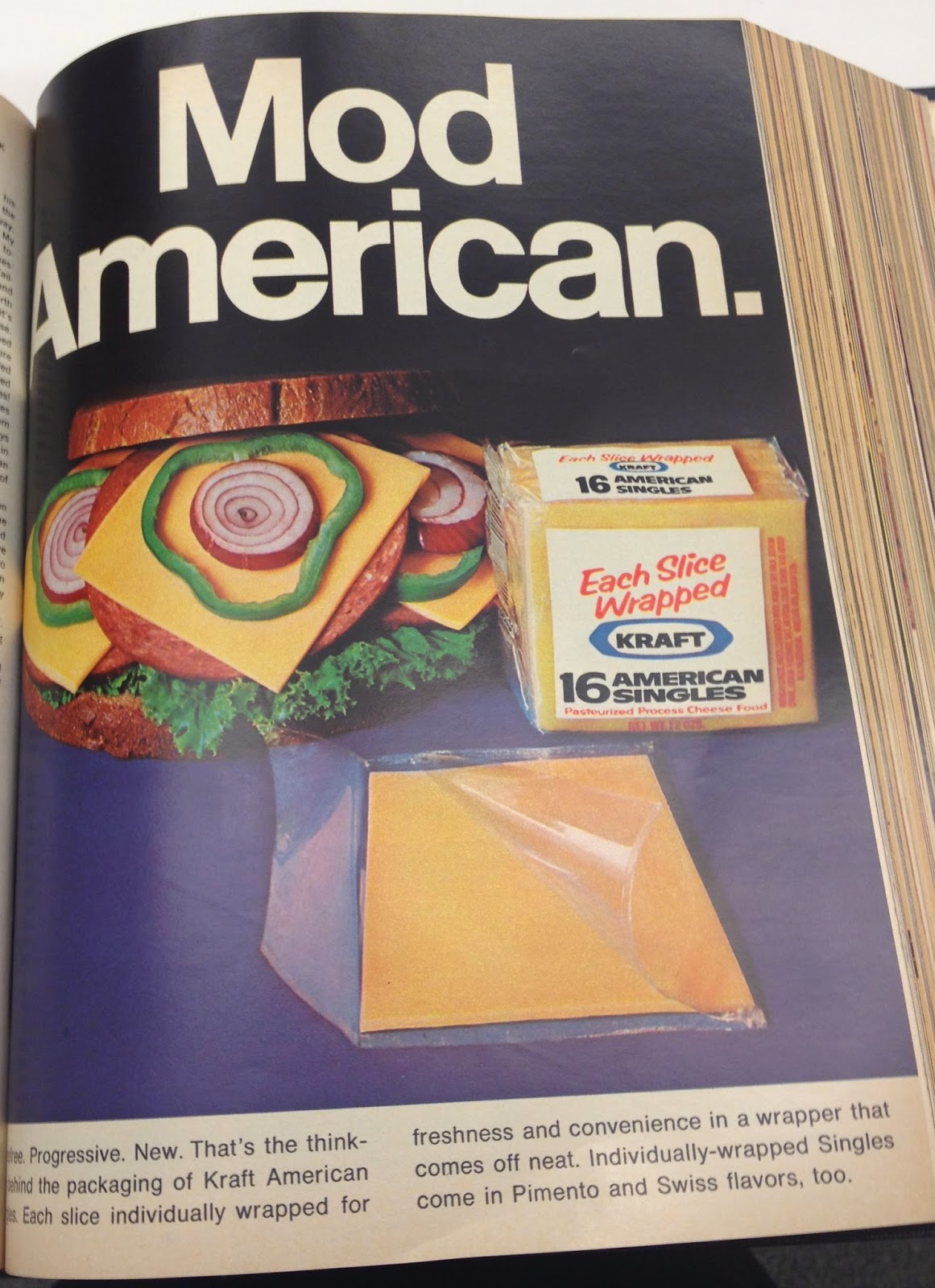
What's the one thing we've noticed the gentlemen of this season eating more than anything else? Sandwiches.
Don in California with Pete. Don with Freddie and some Orange Crushes at the end of the first episode. The chicken salad sandwich Don eats while on pins and needles at the end of "Field Trip," waiting in the creatives' room to meet his fate. That scene juxtaposed with Bobby eating his gumdrops, thinking about the extra sandwich he's given away (I have to guess Matthew Weiner put these scenes side by side for a reason).
The BLT Roger is waiting for in the Algonquin when he gets Don Draper instead.
I think we're seeing a trend this season of working women and apparently also housewives who are doing all they can to look thin and young, including not eating much. And men who are eating a ton of sandwiches because fewer people are making home-cooked meals. Just a theory...we'll see if it keeps happening.
Back to the matchups.
There's a whole lot going on in fashion on "Field Trip." Let's start with Megan, the most fashion-forward of the bunch.
When Don surprises her in L.A., her wardrobe blends with her creepy apartment so well that her curtains might even be the same fabric as her blouse. But it's her crochet-knit vest and skirt that I'm more interested in.
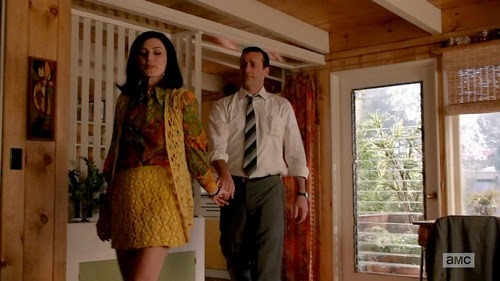
In our everything-old-is-new-again category, check out the near-perfect match on Monica Potter in our June 2014 issue, on newsstands now:
It's been noted that Peggy wears the same outfit this episode that she wore when SCD&P combined with Ted's company last season. Somehow, it looks like a colder color than before, though. Don's been gone so long, that it seems many viewers have forgotten Peggy's reasons to say, "I can't say we miss you." Don't forget that it was his decision to send Ted off to L.A., which effectively ended her relationship with him.
But, in her way, Peggy is very much in style for April 1969. A close match to her coat and skirt appeared in the March GH:
Even the clothing on the extras on this episode were chosen with precision. When a strange woman comes on to Don (as several seem to be doing this season), she's wearing a look straight out of the February 1969 GH:
Why is Weiner having Don turn down these offers left and right this season, by the way? Is it meant to illustrate, as he said recently on NPR to Terry Gross, what a changed man Don has become?
And it's not like I'm ignoring Don's character arc here. As I mentioned in the first post, I just think the focus Weiner's bringing to the female characters this season is really interesting and gels nicely with what was happening in magazines like GH at that time.
One thing that really stood out to me (besides the sandwich ads and abundance of feminine deodorant sprays—that's a combo you'll never see again anywhere else!) in these spring GH issues was the number of stories that featured a large photo of a woman coddling a child. In the March issue in particular, for some reason, the number of these skyrocketed:
And even in the ads, like the ones for beauty products:
Let's hope those 1969 moms were happier and more fulfilled than this one:
Until next time, "Eat your candy."
Friday, May 2, 2014
GH's Throwback Thursday Mad Men Outtakes: "A Day's Work"
As promised, here are my outtakes from the second episode of the season, "A Day's Work."
Episode 7.2: “A Day’s Work”
It’s the second episode of the season, and it’s beginning to seem like the film It’s a Wonderful Life. What is life like without Don Draper in it? What is the office like? One thing’s for sure—there’s clutter, clutter everywhere, both at SC&P and in Don’s swank apartment (or formerly swank). One of the opening scenes of this episode shows Don with his hand in a box of Ritz crackers, watching The Little Rascals on TV. According to my sources, who actually lived through this time period, snacking out of a box like that was relatively unheard of. And yet today you can pop into almost any deli or bodega and be overwhelmed by the vast variety of snack options.
In February 1969, it was just the beginning…
Several women get promoted at work, seemingly randomly, this episode. But I think what lies at the heart of these promotions is their loyalty to the company. Dawn ends up with Joan’s old job by episode’s end, and by then we’ve learned that she’s still updating Don at home on the goings on of the company and wants to do so without extra pay (though Don insists otherwise). Joan, it turns out, has been working two jobs, and finally gets her promotion to ad man.
Peggy, on the other hand, is capsized by the weight of Valentine’s Day and the sheer number of women in the office with flowers on their desks, especially her very own secretary, whose roses she mistakes for her own. “Look at you, every inch a girl,” her employee Stan teases her.
While she seems embarrassed about her meltdown, there’s really very little she can do about it.
And is it just me, or do those roses seem to multiply in size throughout the episode? They look like a dozen at first, and I'm pretty sure someone, Dawn or Peggy, says there are a dozen of them. But by episode's end, there are definitely at least three dozen roses in that vase.
We get an interesting look at race relations of the time period this episode, too. The only two black secretaries in the office, Dawn and Shirley, refer to each other by their own names, a nod to how often their coworkers mix them up. And in an office that has become more and more conservative in the absence of their fearless leader, Shirley is anything but:
But check out her dress doppelganger in the February 1969 GH:
Incidentally, another Shirley, Shirley Chisholm, was the first black woman to join the House of Representatives in 1968, and yet Bert Cooper can’t handle having a black woman work the reception desk at SC&P because “someone might see her.”
Ponder that one.
Until next time, as Sally Draper would say, "Just tell the truth."
Episode 7.2: “A Day’s Work”
It’s the second episode of the season, and it’s beginning to seem like the film It’s a Wonderful Life. What is life like without Don Draper in it? What is the office like? One thing’s for sure—there’s clutter, clutter everywhere, both at SC&P and in Don’s swank apartment (or formerly swank). One of the opening scenes of this episode shows Don with his hand in a box of Ritz crackers, watching The Little Rascals on TV. According to my sources, who actually lived through this time period, snacking out of a box like that was relatively unheard of. And yet today you can pop into almost any deli or bodega and be overwhelmed by the vast variety of snack options.
In February 1969, it was just the beginning…
Several women get promoted at work, seemingly randomly, this episode. But I think what lies at the heart of these promotions is their loyalty to the company. Dawn ends up with Joan’s old job by episode’s end, and by then we’ve learned that she’s still updating Don at home on the goings on of the company and wants to do so without extra pay (though Don insists otherwise). Joan, it turns out, has been working two jobs, and finally gets her promotion to ad man.
Peggy, on the other hand, is capsized by the weight of Valentine’s Day and the sheer number of women in the office with flowers on their desks, especially her very own secretary, whose roses she mistakes for her own. “Look at you, every inch a girl,” her employee Stan teases her.
While she seems embarrassed about her meltdown, there’s really very little she can do about it.
And is it just me, or do those roses seem to multiply in size throughout the episode? They look like a dozen at first, and I'm pretty sure someone, Dawn or Peggy, says there are a dozen of them. But by episode's end, there are definitely at least three dozen roses in that vase.
We get an interesting look at race relations of the time period this episode, too. The only two black secretaries in the office, Dawn and Shirley, refer to each other by their own names, a nod to how often their coworkers mix them up. And in an office that has become more and more conservative in the absence of their fearless leader, Shirley is anything but:
But check out her dress doppelganger in the February 1969 GH:
Incidentally, another Shirley, Shirley Chisholm, was the first black woman to join the House of Representatives in 1968, and yet Bert Cooper can’t handle having a black woman work the reception desk at SC&P because “someone might see her.”
Ponder that one.
Until next time, as Sally Draper would say, "Just tell the truth."
GH's Throwback Thursday Mad Men Outtakes: "Time Zones"
Since I started doing Mad Men "Throwback Thursday" posts for the Good Housekeeping website a week ago, some of you have asked me, "Hey Laura, whatever happens to all those sweet, sweet Diptic match-ups that never make it into your recap?" So, for your viewing pleasure, I'll be posting those outtakes here, on my personal blog, each Friday. There are so many great discoveries in the GH archives that I'd be remiss not to share these with you.
Here are the ones from the first episode.
Episode 7.1: "Time Zones"
Itʼs Mad Menʼs final season, and in seven short years weʼve jumped nine years in TV time—from 1960 to 1969.
The first scene of nearly every season premiere of this much-loved series has centered on our anti-hero, ad man Don Draper, usually panning in on the back of his head, mimicking the animation in the showʼs opening credits. But this season was just a little bit different. The first minutes were filmed through the lens of Donʼs mentee, Peggy Olson (which was also the case in one of the final scenes last season, if you remember).
We the audience watched what she watched, as though we were viewing the 1960s ad world through the eyes of a woman for the first time.
When this series began, the idea of a woman working as an ad executive was laughable. And yet Don knew that his success in advertising relied largely on figuring out what women wanted. In Mad Men's premiere episode, when Don asks a waiter in a restaurant what cigarettes he smokes and why, the man adds that his wife hates it that he smokes because she read in Readerʼs Digest that it could kill him, which he quickly dismisses by saying, “Women sure love their magazines.”
“Yes, they do,” Don agrees.
But that waiter could easily have found the same info in Good Housekeeping, which stopped publishing cigarette ads in 1952. Compared to all other media in the ʼ60s, womenʼs magazines showed the best examples of changing womenʼs roles in society. A study published by The Journal of Psychology in 1992 found a “slow and steady increase in stories with feminist themes” in the years after Betty Friedanʼs 1960 article in GH, the precursor to her The Feminine Mystique.
From now until the end of the season, Iʼll set out to show you examples of those changing roles (and some fashion and beauty, too—promise), as seen through the eyes of characters like Peggy, Joan, Megan, Betty and even Sally, the womenʼs magazine readers of the series and—particularly in Joan and Peggyʼs case—the women whose ideas were changing history.
Before "Time Zones" even aired, we had weeks of promotions from series creator Matthew Weiner, several of which showed the newly L.A.-glamorous Megan Draper. We’ve seen her wear a fall before, but never quite like this. A quick peek into the January 1969 Good Housekeeping reveals a startlingly uncanny example of the trend. Can you tell which is which?
On the left is an illustration by Howard Terpning for an excerpt of a 1968 novel by Norah Lofts, called The Lost Queen. Terpning’s style was similar to that of his contemporary, Brian Sanders, the 75-year-old illustrator Weiner recruited to design the promotional ads for the sixth season of Mad Men, who was also once a regular GH contributor (his artwork appears in the March 1969 issue).
This particular illustration style was often called "bubble and streak," a method that involved mixing soap with gouache paint. Below is an example of Brian's GH work.
And here are some other Megan Draper-esque characters from the February 1969 GH (part of an Avon ad, no less, one of Sterling, Cooper & Partners’ newest clients), along with a close-up of Megan’s makeup at the airport as she greets Don.
In February 1969, GH interviewed six or so acclaimed makeup artists for explanations on how to achieve this look. My favorite part of this is where he calls lavender a "nothing color."
January 1969 would see Richard Nixon’s inauguration, the last public performance by the Beatles and a Southern California oil spill that would inspire a senator to organize the first Earth Day the next year.
After hearing former full-timer Freddie Rumsen’s amazing pitch (which unbeknownst to Peggy was actually conceived by Don, who seems to be using Freddie as a voice box during his paid leave), Peggy tries to adjust the catchphrase for Accutron watches to blend with her own vision, a signature Draper move. It’s not just the opening scenes of this first episode that center on a woman’s perspective—it’s nearly all of it. We don’t even see Don Draper until several minutes in, and even then he is traveling to visit his wife who’s finding success in her acting career in Los Angeles and essentially now lives alone. Other than his work with freelancer Freddie, Don seems to have a good amount of time on his hands (pun intended), though his wife believes he’s still going to work every day.
When Megan picks up Don at LAX, it’s in a new car. His first instinct is to open the passenger’s side door for her, but she whispers to him that she has to be the driver because she can’t figure out how to adjust the seats yet.
Here’s what GH readers thought women knew about cars in January and February 1969.
Around this time, the concept of “the single girl” was becoming prominent in women’s magazines. Whereas models had once been photographed posing in the home, a youthful woman, running around and jumping outside, had become the norm. A single career girl is something Megan has clearly begun to see herself as, despite the fact that she’s already married.
One of the funniest parts of this episode is when a stressed-out Ken Cosgrove scolds secretary-turned-partner Joan Holloway for using his phone to save the Butler Footwear account, one SC&P might have lost had Joan not shown so much ingenuity, despite her sexist treatment by its new head of marketing. Joan’s usually pretty good at conducting these business deals in secret, but this time she slips up and leaves an earring in Ken’s office. Ken throws it at her but misses because of his recent eye injury at the hands of Chevy. Mad Men costumer Janie Bryant was right on when she put those bulky earrings on Joan—they were very trendy that year.
As for Peggy’s wardrobe this season, is anyone else missing those glorious bell bottoms from the sixth season finale? Those pants made a real statement as she hung out in Don’s office like she owned the place. And they were well represented in the January 1969 GH.
She’s still wearing a ton of plaid in 1969, but not in a good way. And she insists on wearing that white knit tam every episode and is veering more towards schoolgirl than fashion-forward woman with those miniskirts and knee socks. Could this change be due to Ted’s absence? Or because of Lou’s oppressive treatment of her?
Either way, according to GH, she’s still in style.
I wish we could say that the despicable Lou Avery isn’t, but even in his cardigan, he has his bases covered.
(I'm making these photos extra small, 'cause frankly, Lou barely deserves to be here.)
What did everyone think of Megan’s very woodsy bungalow in the Hollywood Hills? It definitely doesn’t have Don’s touch, and she scoffs when he tries to add a modern TV to it without asking her permission first (that’s new!). I wonder where she got the idea to decorate with so much wood? Maybe from the January 1969 GH? (Surely not from Playboy.)
That's a bathroom, guys! A bathroom.
By the way, while that orange scarf look Megan's got going on here might seem like a bold and original move on her part (I'm sure Don had meant for her to wear it kerchief-style while driving), it's not. Here's how the ladies were wearing headscarves in 1969.
And, in an everything-that's-old-is-new-again twist, here's how Monica Potter wears one in the June 2014 GH, on newsstands now.
But back to Megan's creepy kitchen. OK, it's not creepy...unless you believe she will be murdered in it by season's end...
Megan’s cooking style is seeing a few changes this season. When Don comes home from visiting Pete and the L.A. offices, prominently displayed on the stove is a casserole dish (though Megan says she’s making Coq au Vin). This time period saw an upswing in casseroles, meant to save the modern woman time in the kitchen.
By the time Don boards his red-eye back to New York, he seems to be feeling fairly ubiquitous ("I wonder if I broke the vessel"—a biblical reference?), or “invisible,” as Pete would say in the next episode. He sits next to a gorgeous middle-aged widow (Neve Campbell in what I believe to be the first wrap dress we’ve seen yet on this series, though von Furstenberg wasn't making these yet then) who offers him sleeping pills, then jokes that he can “blame Madison Avenue” for his misconceptions about glamorous seatmates. When Don refuses, she decides that she’ll hold back, too.
And they’re not the only ones. Millions of readers were getting the same idea from GH that month.
Finally, if you saw the GH recap that showed off the crazy-amazing gingham match-up, you're going to love this. Here's Peggy Olson in her gingham dress, the original gingham-wearer, the O.G....oh, you get the picture.
Until next time, "'Accutron: It's time for a conversation.'"
Here are the ones from the first episode.
Episode 7.1: "Time Zones"
Itʼs Mad Menʼs final season, and in seven short years weʼve jumped nine years in TV time—from 1960 to 1969.
The first scene of nearly every season premiere of this much-loved series has centered on our anti-hero, ad man Don Draper, usually panning in on the back of his head, mimicking the animation in the showʼs opening credits. But this season was just a little bit different. The first minutes were filmed through the lens of Donʼs mentee, Peggy Olson (which was also the case in one of the final scenes last season, if you remember).
We the audience watched what she watched, as though we were viewing the 1960s ad world through the eyes of a woman for the first time.
When this series began, the idea of a woman working as an ad executive was laughable. And yet Don knew that his success in advertising relied largely on figuring out what women wanted. In Mad Men's premiere episode, when Don asks a waiter in a restaurant what cigarettes he smokes and why, the man adds that his wife hates it that he smokes because she read in Readerʼs Digest that it could kill him, which he quickly dismisses by saying, “Women sure love their magazines.”
“Yes, they do,” Don agrees.
But that waiter could easily have found the same info in Good Housekeeping, which stopped publishing cigarette ads in 1952. Compared to all other media in the ʼ60s, womenʼs magazines showed the best examples of changing womenʼs roles in society. A study published by The Journal of Psychology in 1992 found a “slow and steady increase in stories with feminist themes” in the years after Betty Friedanʼs 1960 article in GH, the precursor to her The Feminine Mystique.
From now until the end of the season, Iʼll set out to show you examples of those changing roles (and some fashion and beauty, too—promise), as seen through the eyes of characters like Peggy, Joan, Megan, Betty and even Sally, the womenʼs magazine readers of the series and—particularly in Joan and Peggyʼs case—the women whose ideas were changing history.
Before "Time Zones" even aired, we had weeks of promotions from series creator Matthew Weiner, several of which showed the newly L.A.-glamorous Megan Draper. We’ve seen her wear a fall before, but never quite like this. A quick peek into the January 1969 Good Housekeeping reveals a startlingly uncanny example of the trend. Can you tell which is which?
On the left is an illustration by Howard Terpning for an excerpt of a 1968 novel by Norah Lofts, called The Lost Queen. Terpning’s style was similar to that of his contemporary, Brian Sanders, the 75-year-old illustrator Weiner recruited to design the promotional ads for the sixth season of Mad Men, who was also once a regular GH contributor (his artwork appears in the March 1969 issue).
This particular illustration style was often called "bubble and streak," a method that involved mixing soap with gouache paint. Below is an example of Brian's GH work.
And here are some other Megan Draper-esque characters from the February 1969 GH (part of an Avon ad, no less, one of Sterling, Cooper & Partners’ newest clients), along with a close-up of Megan’s makeup at the airport as she greets Don.
In February 1969, GH interviewed six or so acclaimed makeup artists for explanations on how to achieve this look. My favorite part of this is where he calls lavender a "nothing color."
January 1969 would see Richard Nixon’s inauguration, the last public performance by the Beatles and a Southern California oil spill that would inspire a senator to organize the first Earth Day the next year.
After hearing former full-timer Freddie Rumsen’s amazing pitch (which unbeknownst to Peggy was actually conceived by Don, who seems to be using Freddie as a voice box during his paid leave), Peggy tries to adjust the catchphrase for Accutron watches to blend with her own vision, a signature Draper move. It’s not just the opening scenes of this first episode that center on a woman’s perspective—it’s nearly all of it. We don’t even see Don Draper until several minutes in, and even then he is traveling to visit his wife who’s finding success in her acting career in Los Angeles and essentially now lives alone. Other than his work with freelancer Freddie, Don seems to have a good amount of time on his hands (pun intended), though his wife believes he’s still going to work every day.
When Megan picks up Don at LAX, it’s in a new car. His first instinct is to open the passenger’s side door for her, but she whispers to him that she has to be the driver because she can’t figure out how to adjust the seats yet.
Here’s what GH readers thought women knew about cars in January and February 1969.
Around this time, the concept of “the single girl” was becoming prominent in women’s magazines. Whereas models had once been photographed posing in the home, a youthful woman, running around and jumping outside, had become the norm. A single career girl is something Megan has clearly begun to see herself as, despite the fact that she’s already married.
One of the funniest parts of this episode is when a stressed-out Ken Cosgrove scolds secretary-turned-partner Joan Holloway for using his phone to save the Butler Footwear account, one SC&P might have lost had Joan not shown so much ingenuity, despite her sexist treatment by its new head of marketing. Joan’s usually pretty good at conducting these business deals in secret, but this time she slips up and leaves an earring in Ken’s office. Ken throws it at her but misses because of his recent eye injury at the hands of Chevy. Mad Men costumer Janie Bryant was right on when she put those bulky earrings on Joan—they were very trendy that year.
As for Peggy’s wardrobe this season, is anyone else missing those glorious bell bottoms from the sixth season finale? Those pants made a real statement as she hung out in Don’s office like she owned the place. And they were well represented in the January 1969 GH.
She’s still wearing a ton of plaid in 1969, but not in a good way. And she insists on wearing that white knit tam every episode and is veering more towards schoolgirl than fashion-forward woman with those miniskirts and knee socks. Could this change be due to Ted’s absence? Or because of Lou’s oppressive treatment of her?
Either way, according to GH, she’s still in style.
I wish we could say that the despicable Lou Avery isn’t, but even in his cardigan, he has his bases covered.
(I'm making these photos extra small, 'cause frankly, Lou barely deserves to be here.)
What did everyone think of Megan’s very woodsy bungalow in the Hollywood Hills? It definitely doesn’t have Don’s touch, and she scoffs when he tries to add a modern TV to it without asking her permission first (that’s new!). I wonder where she got the idea to decorate with so much wood? Maybe from the January 1969 GH? (Surely not from Playboy.)
That's a bathroom, guys! A bathroom.
By the way, while that orange scarf look Megan's got going on here might seem like a bold and original move on her part (I'm sure Don had meant for her to wear it kerchief-style while driving), it's not. Here's how the ladies were wearing headscarves in 1969.
And, in an everything-that's-old-is-new-again twist, here's how Monica Potter wears one in the June 2014 GH, on newsstands now.
But back to Megan's creepy kitchen. OK, it's not creepy...unless you believe she will be murdered in it by season's end...
Megan’s cooking style is seeing a few changes this season. When Don comes home from visiting Pete and the L.A. offices, prominently displayed on the stove is a casserole dish (though Megan says she’s making Coq au Vin). This time period saw an upswing in casseroles, meant to save the modern woman time in the kitchen.
By the time Don boards his red-eye back to New York, he seems to be feeling fairly ubiquitous ("I wonder if I broke the vessel"—a biblical reference?), or “invisible,” as Pete would say in the next episode. He sits next to a gorgeous middle-aged widow (Neve Campbell in what I believe to be the first wrap dress we’ve seen yet on this series, though von Furstenberg wasn't making these yet then) who offers him sleeping pills, then jokes that he can “blame Madison Avenue” for his misconceptions about glamorous seatmates. When Don refuses, she decides that she’ll hold back, too.
And they’re not the only ones. Millions of readers were getting the same idea from GH that month.
Finally, if you saw the GH recap that showed off the crazy-amazing gingham match-up, you're going to love this. Here's Peggy Olson in her gingham dress, the original gingham-wearer, the O.G....oh, you get the picture.
Until next time, "'Accutron: It's time for a conversation.'"
Subscribe to:
Posts (Atom)


